


WASHINGTON — While iconoclastic directors like Tim Burton and John Waters grew up imagining Vincent Price was their friend, Victoria Price called him “dad.”
And as it turns out, the man who so convincingly played sorcerers, rakes, monsters, homicidal maniacs — even death itself — was to her, the biggest hero there was.
“He was a loving, kind, generous, funny, totally un-scary man,â€� Victoria told Â鶹¹ÙÍø of her late father, who died exactly 23 years ago on Oct. 25, 1993 at age 82. “We were really close. I was a daddy’s girl.â€�
Fans of classic films, especially those of the “fright night” variety, think of Price as a series of well-played characters. His incomparable voice — a rich mixture of debonair, playful, devilish and foreboding — was his signature; his angular face and tall frame evoking characters forever associated with dark dungeons, lonely castles and crypts.
But for Victoria, who was born in 1962 when Price was 51 and well into his horror heyday, her dad was much more than a “titan of terror.â€� When she was nearly 10, he played Dr. Hubert Whitehead, the paranoid archaeologist who captures Greg, Peter and Bobby Brady and ties them up in his cave during the ““ two-part TV special in 1972. That was more her speed.
“I watched the things in which he spoofed himself, but I didn’t watch the things where he scared people — I just couldn’t do it. I was an impressionable kid,â€� said Victoria, now an accomplished interior designer, art consultant, public speaker and author whoÌý±è³Ü²ú±ô¾±²õ³ó±ð»å in 1999, with an update in 2014, as a labor of love.
“It just frankly scared me too much,â€� she said of her father’s movies, which, by the time she was old enough to watch, included the twisted “,â€� ““ and “.â€�
She saw none of them, and for his part, Price left his work at the studio.
“When people said my dad was scary, I was like, ‘Are you kidding?’” she said. “It seemed unbelievable to me that anyone would be scared of this totally sweet man.â€�
Now in her 50s, Victoria has easily assumed the caretaker role of his legacy, which she celebrates with both ease and dedication. She is often called upon to talk about Vincent Price and she does so enthusiastically. She knows that it is more than just his movies that keep his popularity alive.
“When he was alive, people called him a renaissance man,” she said. “I think that was a way to package him, the fact that he loved so many things. He was curious about so many things. People who love my dad get that; they get all of him.â€�
Starting out as a fine arts scholar at Yale and the University of London, Price had the pedigree of pilgrims and wealth of early American entrepreneurs, but wound up taking another path. Acting took him onto the screen during the Golden Age of Hollywood, where he often played secondary roles, though in his very first film, (1938),Ìýhe shared the marquee with actress Constance Bennett.
He soon distinguished himself as a scene chewer, both as a villain and comic relief, upstaging Robert Mitchum and Jane Russell as ham actor Mark Cardigan (some say himself!) in the 1951 crime drama He’s top-billed with the other two and for a reason — Price has the heft to carry a film, in fact, his scenes are arguably the best in the movie. He’s outlandish and compelling, playing an ultimately charming fool, accessible and funny.
It’s his ability to take the gentleman rogue and charming third man to new levels, while at the same time be relatable to the viewing public, that put him on a path of success. He was a standout at a time when Hollywood was pumping out conventional screen idols as if on an assembly line.
So it’s no surprise, says daughter Victoria, that he fell naturally into the emerging new horror era of the 1950s, helping make (1953) one of the most popular scary movies of all time.
“When he discovered Gothic villainy in the 1940s, he loved it,â€� she said, pointing to his first foray playing the high-handed landowner to Gene Tierney’s ingénue in (1946), which reunited Tierney and Price just two years after Otto Preminger’s film-noir classic “Laura” (1944).
Later, Price turned out to be perfect for Edgar Allan Poe adaptations, of which he did eight with director Roger Corman, the master of the low-budget yet sumptuous Gothic horror production.
“Working with Corman was a chance to work in that genre, to have his name forever associated with probably the greatest original American literary voice (Poe), and also a chance to keep working and staying current, when so many of his peers were not,â€� she told Â鶹¹ÙÍø.
Indeed, while many of Price’s peers from the Golden Age were playing fathers in teeny-bopper films or finding sanctuary in war movies and westerns, Price was able to flex his chops on an expanding Hollywood canvas. Once filmmaking began to transform with the Hollywood renaissance of the ’60s, the old studio system gone and counterculture setting in, Price, like everything else, embraced it.
“He was somebody who wanted to be current, was interested in what was current, not just to be popular, but it was about being alive in the world, in the moment, and I think that is a really interesting, important aspect about my dad,� Victoria said, adding that he surrounded himself with “people who loved life,� no matter what age or background.
This was no more evident than in his brilliant in 1982, introducing a new generation to his talents.
“I think that was something he did really well — he bridged eras,” she said.
He dove into his projects and never sneered at ludicrous, cheesy characters or plots, never winked at the audience to suggest it was all joke.
“He felt the job of an actor was to make the unbelievable, believable — he actually said that,â€� she said. “No matter how ‘far out’ what he was doing [was], people bought into it because they wanted to buy into it and that is a unique thing because, let’s be honest, the things he was doing were way out there, very outlandish.â€�
In a first broadcast on Turner Classic Movies in 2013, director John Waters, who said ‘“House on Haunted Hill� actually inspired his own pioneering career, noted, “He was not campy. Campy suggests someone is so bad they are good. Vincent Price was so great he was perfect.�
He also described Price as “never pretentious … the audiences who went to see him were all inclusive, from the poorest people to the richest. Nobody disliked him.�
Price would have surely liked that line, as he was also known to have fully embraced social justice and civil rights long before others caught on. He came out early against Nazism in the ’30s, spurned segregation and hate in the ’50s, and when Victoria came out as gay in her adulthood, he gave her his full understanding and love.
“He was somebody who really did not see difference — he saw us all as being connected and one, and he was a populist,” she said. “He was anti-elitist, he was tolerant and accepting and kind and promoted freedom of all kinds. What a gift to grow up with someone like that.â€�
With Victoria, he shared his other great passions — art and cooking. He and her mother would travel the world and brought back many of the amazing recipes of the period, from the Tuscan countryside to the best restaurants in Paris and Holland and Scandinavia.
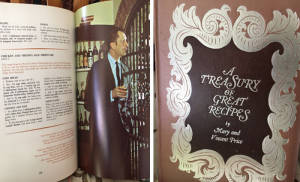
Their gorgeously packaged ““ (1965) is now in its second printing and is considered a classic. It is not only filled with recipes but international, original menus and glossy photographs of the dining rooms, food, kitchens and the Price couple, wholly engaged in culinary learning and the delicacies of the times.
“It was the eighth most popular out-of-print book of any kind. That’s why we did the 50th anniversary edition last year,� Victoria said.
The couple’s 1965 book “Come into the Kitchen” is slated for a . Given the enormous amount of celebrity and niche cookbooks over the decades, what’s the enduring appeal?
“I think it’s a time capsule,� she said. “I think it captured who my dad was, that he was this omnivorous human being — and I don’t just mean in regards to food. He just wanted to eat life up. I really feel that it’s kind of what still makes it so alive, that comes through. The ‘aliveness’ comes through.�
Price was also a voracious art collector and patron, founding the  in 1957 deliberately in East Los Angeles to promote art to the less advantaged. Price’s daughter is a board member at the museum, which holds more than 9,000 works in three buildings and provides an arts program for students at East Los Angeles College each year, including a new performing and fine arts center.
Toward the end of his life, father and daughter were as close as ever, their love for the creative arts a lifelong bond.
“So many kids struggle to have their parents’ support in what they want to do,” she said. “How fortunate am I?â€�
She recalled a letter her father sent her shortly before his death, sharing how happy he was that their friendship kept growing.
“I loved reading that,” she said. “It was such an acknowledgment of what I always felt, but to see it from him was wonderful.”
It was a bittersweet moment to share the stage with her father on his last film, Tim Burton’s (1990). Burton, who once said Price’s movies had carved out a special role for his idol Price, not knowing his character’s death in the movie would precede his real-life death to Parkinson’s disease and emphysema just a few years later.
“I love that [the movie] is there, but it is definitely emotional for me,” said Victoria, who played a bit part as a newscaster. “It’s so much him at the end of his life.”
Today, she tends a devoted to her dad and fields the many letters from people who, like Burton and Waters, say her father inspired them in immeasurable ways.
“What a gift for me, to share someone I loved so much, my dad, with other people,” she said.
And what a gift that is for the rest of us.
See the gallery above for Price’s best Halloween roles. Listen to the full interview with Victoria Price below.


